Rebalance
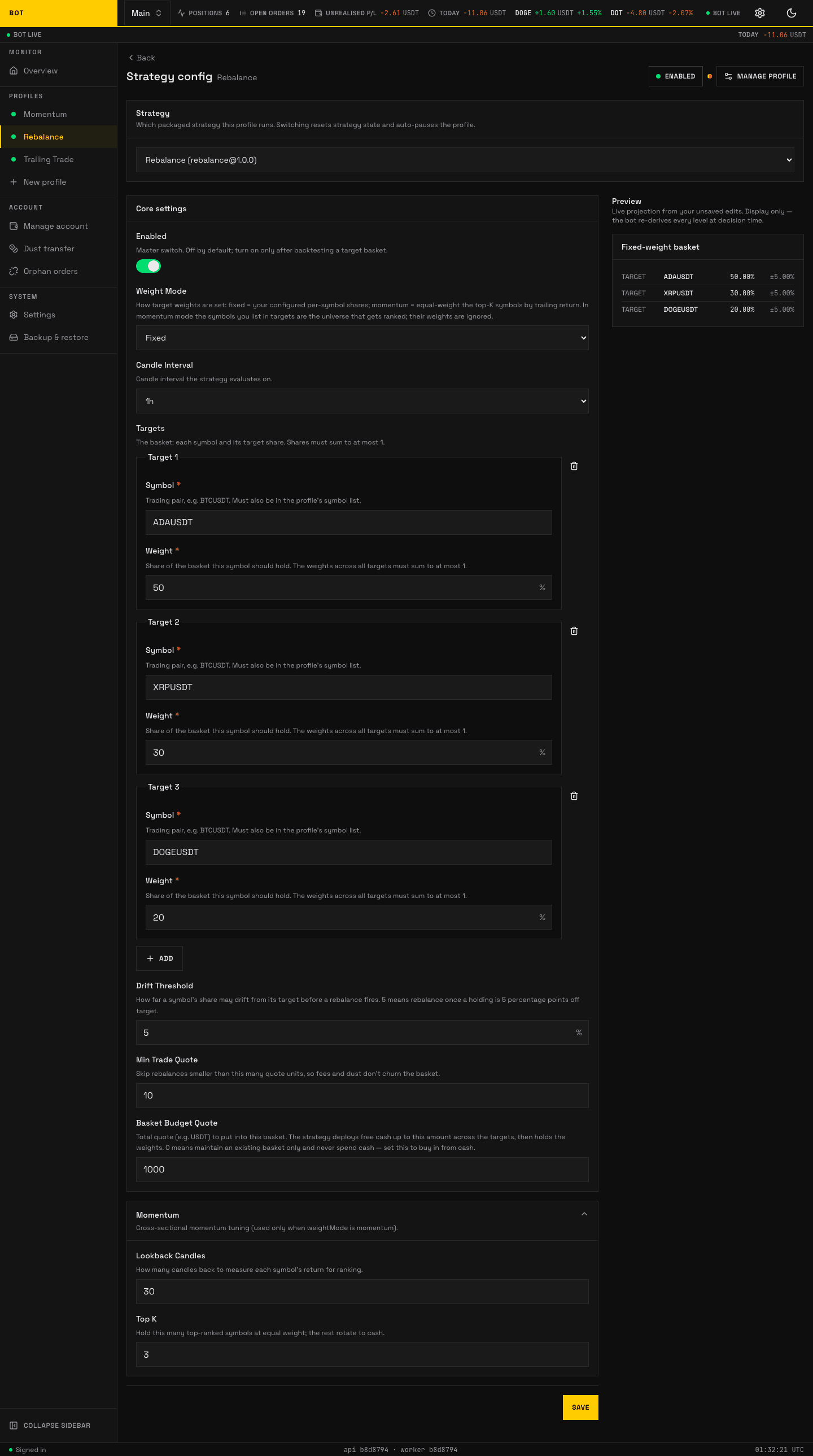
The Rebalance configuration form, as the profile's Strategy section renders it. Every field is documented in the table below. Seeded demo data, not a real account.
Configuration form
Rebalance is configured on the same profile Strategy section shown for Momentum and Trailing Trade; the form renders the fields documented below. (No live Rebalance profile existed on the demo account when these screenshots were taken.)
Rebalance ignores timing and instead holds a basket of coins at target proportions. As prices drift, it sells what grew past its target and buys what fell below, mechanically selling high and buying low to restore the mix. It makes no market-timing calls; it only corrects drift.
This page is the canonical reference for the strategy — what it does, how each tick decides, every configuration knob, worked examples, the state it keeps, and its internals. It serves both an operator configuring a profile and a contributor reading the code (packages/strategy/rebalance/).
In one sentence
You set target shares for a basket of coins; whenever a coin's actual share drifts far enough from its target, the bot buys or sells just enough to bring it back.
Two modes
weightMode chooses how the target shares are set:
- Fixed weights (
'fixed', default) — you set each coin's share directly intargets. For example BTC0.4, ETH0.4. Weights across the basket must sum to at most 1; whatever is left over stays as cash. You do not configure a "cash" target — cash is simply the unallocated remainder. - Momentum weights (
'momentum') — the per-coin weights intargetsare ignored; the list becomes the ranked universe. Each tick ranks the coins by recent return and holds the toptopKat equal weight, rotating the rest to cash as the ranking changes. This is cross-sectional momentum riding the rebalance engine.
How a tick decides
Rebalance is a cross-symbol strategy: each coin's tick needs to know the value of the whole basket. It gets that through a per-profile key-value store — every tick each coin publishes its own mark-to-market value, and reads back its siblings' values to reconstruct the basket total.
flowchart TD
    Start["New price update for one coin"]:::io
    Mode{"Weight mode?"}:::gate
    Fixed["Target = this coin's<br/>configured share"]:::core
    Rank["Rank the universe by return,<br/>target = equal share if in the top K,<br/>else zero"]:::core

    Basket["Reconstruct basket value<br/>from published sibling values<br/>plus deployable cash"]:::core
    Drift{"Actual share vs target:<br/>drift past the threshold?"}:::gate
    Trade["Buy if underweight,<br/>sell if overweight,<br/>above the minimum trade size"]:::act
    Hold["Hold, record the reason"]:::wait
    Publish["Publish this coin's value<br/>to the shared store"]:::io

    Start --> Mode
    Mode -->|fixed| Fixed --> Basket
    Mode -->|momentum| Rank --> Basket
    Basket --> Drift
    Drift -->|yes| Trade --> Publish
    Drift -->|no| Hold --> Publish

    classDef io fill:#2c3e50,color:#ffffff;
    classDef core fill:#1f6f43,color:#ffffff;
    classDef gate fill:#f0ad4e,color:#2c3e50;
    classDef act fill:#1f6f43,color:#ffffff;
    classDef wait fill:#ecf0f1,color:#2c3e50;
All orders are MARKET orders — Rebalance never rests an order on the book. Trades below minTradeQuote are skipped so fees and dust do not churn the basket.
Configuration
The in-app form and the table below are generated from the same schema, so the fields, labels, and help below are exactly what you see in the profile's Strategy section. The momentum.* fields apply only when weightMode is momentum. The default config is inert (enabled: false, empty basket) — turn it on only after backtesting a target basket.
Keep lookbackCandles at or below 199
The candle window floors at 200 (rebalanceRequiredWindow). A lookbackCandles
above 199 asks momentumScore for a close further back than the window carries,
so every coin scores null, no coin ever ranks, and the basket never deploys —
silently, and identically in live and backtest.
Per-symbol overrides may change only targets; every other field is profile-wide.
How momentum mode ranks
Momentum works far better across coins than on one coin in isolation. Timing a single coin on a moving-average cross is the weak form — prone to whipsaw, being shaken out by rapid up-then-down swings that trip the signal in both directions. Ranking a whole universe by trailing return and holding only the strongest few ("cross-sectional" momentum, because the comparison runs across coins at one moment rather than one coin over time) sidesteps that. This is also why momentum mode is a weight mode of Rebalance rather than its own package: holding the top topK and rotating the rest to cash is dynamic-weight rebalancing, so it reuses the same order engine, drift logic, and budget unchanged.
Each coin scores itself by trailing return over lookbackCandles (lastClose / closeNAgo − 1) and publishes that score to the shared store. It reads its siblings' scores, ranks the whole universe descending (ties broken by symbol for reproducibility), and:
- If it ranks in the top
min(topK, universeSize), its target is an equal1 / heldshare, and the drift path buys toward it. - If it ranks below that, its target is
0and it rotates fully to cash.
Two guards prevent bad early behaviour: a coin with too little history or a data gap scores null and holds (never sells on a gap), and no coin deploys until enough of the universe has published scores (the convergence gate), so the first coin to warm up cannot grab the whole budget.
A starting configuration
A three-coin basket held at fixed weights.
enabled: true
weightMode: fixed
candleInterval: 4h
basketBudgetQuote: '1000' # deploy $1,000 into the basket
driftThreshold: '0.05' # correct once a holding is 5 points off target
minTradeQuote: '10' # skip corrections smaller than $10

targets:
  - { symbol: BTCUSDT, weight: '0.5' }
  - { symbol: ETHUSDT, weight: '0.3' }
  - { symbol: SOLUSDT, weight: '0.2' }
How it plays out. The bot buys toward 50/30/20 until $1,000 is deployed, then simply holds those proportions. If BTC rallies to 58% of the basket, that is 8 points of drift, past the 5-point threshold, so it sells enough BTC to come back toward 50% and buys the underweight coins with the proceeds. Corrections worth less than $10 are skipped, so ordinary wobble does not churn fees. Note the weights sum to 1.0 — using 0.4/0.3/0.2 instead would deliberately hold the remaining 10% as cash.
To rotate rather than hold, set weightMode: momentum and momentum.topK: 2; the three targets then become the candidate pool and the two strongest are held at 50% each.
Worked scenarios
Fixed 60/40, drifting. targets BTC 0.6, ETH 0.4, driftThreshold '0.05'. BTC rallies until it is 68% of the basket. On BTC's next tick the drift (8 points) exceeds the threshold — it sells enough BTC to bring it back toward 60%. On ETH's tick, ETH is now underweight, so it buys ETH with the freed cash. The mix is restored.
Deploying fresh cash. Same basket with basketBudgetQuote '1000' and $1,000 of free quote. The bot buys toward the targets until $1,000 is deployed across the basket, then only corrects drift. With basketBudgetQuote '0' it would never spend the cash — it would only rebalance coins you already hold.
Momentum rotation. weightMode 'momentum', universe of 5 coins, topK 3. The bot holds the 3 strongest at about 33% each. A held coin weakens and drops to rank 4 — its target becomes 0 and the bot sells the whole position (rotate-exit); the coin that rose into the top 3 gets bought toward its equal share.
State it keeps
Per (profile, symbol), rebalance keeps only the position (RebalanceStateSchema, schema version 1.0.0):
| Field | Tracks |
|---|---|
avgEntryPrice |
Average entry price of the held position; null when flat. |
heldQuantity |
Base quantity held; null when flat. |
The persisted state holds no basket-wide target or sibling data. The whole-basket view is reconstructed each tick from the shared key-value store, not from state. The tick itself never mutates the position — fills are applied out-of-band by the position adapter.
Internals
- Cross-symbol KV seam. Each tick publishes this coin's value under
rebalance:value:<symbol>(and, in momentum mode, its score underrebalance:momentum:<symbol>) viaset-kvdecisions, and reads siblings back. This is the one place the per-(profile, symbol) purity rule opens a coordinated seam, and it is why rebalance declaresneedsProfileKv: true. - No events. Rebalance declares no domain events (
events: {}). Output is decisions (set-kv,delete-kv,place-order), therebalance.decisionmetric tagged with a reason (within-drift,rotate-exit,below-min-trade, …), and logs. - Market only. It never rests an order, so there is nothing to adopt or attribute. If it ever grows a resting order type, that change must add order attribution in the same commit — noted in the code as a hard rule.
- Purity. The tick is pure
Decimalmath with no I/O. The executor guarantees an order is never placed twice, even across a crash.
What it does not do
- No market timing — it corrects drift on a schedule, it does not predict direction.
- No shorting or derivatives — spot long only.
- With
basketBudgetQuote '0'it never spends fresh cash; it only rebalances holdings. - On a data gap a coin holds rather than selling — momentum mode never rotates on missing data.
See also
- Compare the three strategies
- Strategy plugin contract
- Source:
packages/strategy/rebalance/