Orphan orders
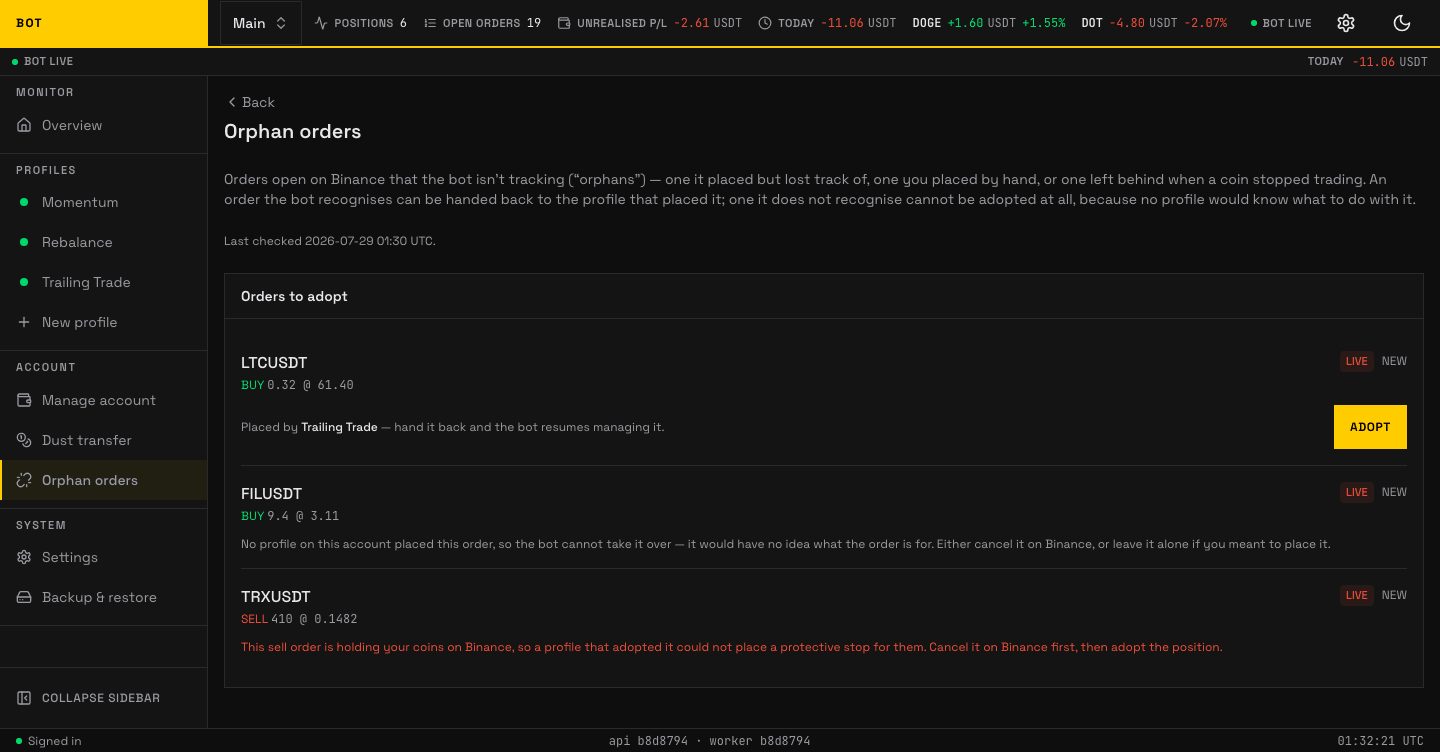
The Orphan orders page. Open Binance orders the bot is not tracking, ready to adopt or cancel. Seeded demo data, not a real account.
An orphan order is an order open on Binance that the bot is not tracking — one it placed but lost track of, one you placed by hand, or one left behind when a coin stopped trading. A background scan finds them every few minutes.
The Orphan orders page lets you hand a recognised one back to the profile that placed it ("adopt"), so the bot resumes managing it — trailing its stop and counting its fills.
What you see
The Orders to adopt panel lists each orphan with its symbol, side (BUY/SELL), quantity and price, a Live/Testnet badge, and status. A line at the top shows when the scan last ran. When everything is tracked you see "No orphan orders — every order open on Binance is already tracked by the bot."
Adopting
- Adoptable — placed by a profile the bot recognises. Its row shows "Placed by {profile} — hand it back and the bot resumes managing it" with an Adopt button. A confirmation ("Hand this order back?") summarises the order before you confirm.
- Not adoptable — either no profile on the account placed it (the bot cannot determine what it is for), or it is a resting sell holding your coins (a profile could not place a protective stop for them). In both cases the page tells you to cancel it on Binance first, or leave it alone if you meant to place it.
How adoption works
An orphan is an order that is open on Binance's book but that no local orders row tracks. The bot did not place it, or placed it and lost the record — either way it is not managing it. The orphan-orders-detect cron finds them, running every 10 minutes.
The Orphan orders page and the adopt UI show the raw single-tick diff, so an orphan can appear on its first sighting. The two-tick confirmation gates only the push notification: the alert fires only for an orphan seen on two consecutive ticks (about 10 minutes apart), so a just-canceled order the bot is repricing right now does not alert. The seen-this-tick set carries a roughly 25 minute TTL (SEEN_TTL_S = 1500, about 2.5 cron periods), so if the cron skips a cycle the two-tick count restarts from scratch rather than trusting a stale prior set.
flowchart TD
    Fetch["Fetch open orders per account"]:::io
    Diff["Diff vs live order ids"]:::core
    RawOut["Raw single-tick diff"]:::act
    Page["Orphan orders page / adopt UI"]:::act
    TwoTick{"Seen this tick AND seen last tick?"}:::gate
    Push["Push notification"]:::act

    Fetch --> Diff
    Diff --> RawOut --> Page
    Diff --> TwoTick
    TwoTick -- "yes" --> Push

    classDef io fill:#2c3e50,color:#ffffff;
    classDef core fill:#1f6f43,color:#ffffff;
    classDef gate fill:#f0ad4e,color:#2c3e50;
    classDef act fill:#1f6f43,color:#ffffff;
    classDef wait fill:#ecf0f1,color:#2c3e50;
An orphan is not harmless. A resting order locks its base asset: the coin it would sell is reserved by Binance and shows as locked, not free. If the true owner of that coin is one of your profiles, that profile can only protect the part of the position the orphan leaves free: the strategy sizes its protective stop on min(tracked position, free + what its own resting stop holds) and arms that partial stop, because protecting most of a position beats protecting none of it. When the orphan leaves nothing usable free — nothing at all, or too little to clear Binance's minimum order size — no stop can be placed, and the symbol shows a No stop blocker naming the order to cancel. The bot places nothing in that state (a stop Binance can only refuse -2010 would otherwise be re-sent every tick) and cancels nothing, so the position rides unprotected until you clear the orphan.
The destination is derived, never chosen
There is deliberately no picker. The bot adopts an orphan only into the profile that can prove it placed it — by recomputing its own deterministic clientOrderId scheme and matching the id on the order. Exactly one claimant means the order goes home. Zero claimants, or more than one, and the adopt is refused (409).
This is not timidity. Handing a resting order to a profile that did not place it is strictly worse than leaving it: the foreign strategy does not recognise the id, so it can neither reprice nor cancel it, the base asset stays locked forever, and the profile that does own the coin stays wedged. A wrong adopt is unrecoverable without manual exchange access; a refused adopt costs you one click on Binance.
Which orders are derivable, per shipped strategy:
| Strategy | Derivable ids | Not derivable |
|---|---|---|
trailing-trade |
the first buy, every grid-ladder buy, bull-pyramid adds, and the protective stop | take-profit sells and manual orders, whose ids fold the entry price or the override id |
momentum |
the protective stop (keyed on profile + symbol) | entry / exit orders, whose ids fold the triggering candle's time |
rebalance |
— (places only MARKET orders, which never rest, so it cannot orphan one) |
— |
A derivable id is one the strategy can recompute from settings alone. An id that folds in something only the running bot knew — the exact entry price, the id of the override that triggered a manual order — cannot be re-derived later, so the strategy correctly declines to claim it rather than guess.
When the bot says it cannot adopt
Your options are cancel it or leave it, and the page says which orphan is which.
- Cancel it on Binance — the normal answer. Do this whenever the order is not one you deliberately placed by hand: it was placed by another bot, by an older deployment, or its id folds runtime data no strategy can re-derive. Cancelling frees the base asset, and the owning profile arms its protective stop on the next tick with no further action from you.
- Leave it — only if it is a manual order you actually want to rest. Understand the cost: for as long as it rests it holds that base asset
locked, which is precisely what caps the true owner's protective stop at the free remainder. If the coin is one a profile is trading, leaving the orphan means leaving that position partly — or, when it locks nearly all of it, entirely — unprotected.
The bot never cancels an orphan for you. It did not place the order and cannot know you did not mean it.
One exception: deleting a profile. A delete has to leave the exchange clean, so it scans the whole account's open orders and cancels the ones it can prove the deleted profile placed. Two proofs count, either one enough: the strategy re-deriving the clientOrderId (the same proof the adopt page uses), or a DB row that profile recorded (matched on symbol + Binance order id, so an order the bot logged but whose id it cannot re-derive is still provably its own). That is deliberate: an order left resting by a profile that no longer exists is an order nothing in the system points at any more, and that is exactly how a deleted profile's stop went on holding a position's coins for days. An order neither proof claims — a manual order of yours, a sibling profile's, or one both unenumerable and never recorded — is still never cancelled: you are notified about it instead, and it does not block the delete. The orphan-orders-detect cron and the Orphan orders page never cancel anything.